Book Review: The Warning by K. A. Applegate

Book #247 of 2021:

The Warning by K. A. Applegate (Animorphs #16)

The internet stuff in this novel is fairly dated, with AOL-style chat rooms and explanations of screen names and browser cookies, but only because the technology has moved on in the decades since 1998, never in a way that seems like author K. A. Applegate didn’t know what she was talking about back then (although I wish she hadn’t glossed past the disturbing detail that the underage Marco is being catfished by a seventy-three-year-old posing as a pretty girl to send him flirty emails). And the rest of the story is top-notch, from a harrowing ordeal in fly morph to the increasing stress of these life-or-death missions and Jake’s unwanted leadership role in them to a difficult ethical decision about collateral civilian casualties that pits Animorph against Animorph and doesn’t seem to have a clear solution. It’s par for the course for this franchise, but pretty heavy material for a teen to have to shoulder!

Which makes it all the more validating in the final pages when the protagonist’s mother, not even knowing what he’s going through, rejects what she was told as a child that “anything a kid would feel would be less difficult or painful than what an adult would feel” and instead remarks, “In a lot of ways being a kid is worse than being an adult.” Hopefully no young reader has secretly-fighting-alien-invaders levels of problems, but our own battles can certainly feel that extreme in middle and high school, and it’s refreshing to hear media messaging that explicitly acknowledges it. The ending isn’t as tidy as usual either, skillfully leaving open a few questions to linger unnervingly on our minds.

On a lighter note, this volume also contains a few of those scenes with the team ‘speaking’ or otherwise acting non-animal-like to random bystanders while morphed, which are generally a delight. Here for instance we get perhaps my all-time favorite distraction in the series: Rachel as a grizzly bear mopping a carpeted floor while Marco and Ax sneak around a corporate office behind the understandably perplexed onlookers. There’s some solid amusement later on too, when Jake takes the form of a rhinoceros and has to be guided by the others due to his poor eyesight and tendency to just run straight through or over any obstacle in his path. These books don’t always handle the tricky transitions between their playful and serious tones so well, but for this particular title, it’s a success throughout.

[Content warning for body horror and cannibalism.]

★★★★☆

–Subscribe at https://patreon.com/lesserjoke to support these reviews and weigh in on what I read next!–

Find me on Patreon | Goodreads | Blog | Twitter

TV Review: Star Wars Rebels, season 4

TV #70 of 2021:

Star Wars Rebels, season 4

There are two resonant character farewells in this last year of Star Wars Rebels: first in the episode “Jedi Night” and then in the overall finale. We also get the surprise return of Ahsoka Tano following her apparent death two seasons back, which may have worked better for audiences upon airing than for folks like me who have already seen her later appearance on The Mandalorian, but is still pretty satisfying regardless. (On the other hand, that development somewhat bizarrely introduces time travel into the franchise as well, never to be picked up again elsewhere to my knowledge.)

The rest of the run is a little more mixed, not quite finding good storylines for everyone and getting bogged down in way too much local Lothal nonsense, including a new species of mystical animals for the young hero to commune with and befriend. I initially liked how this cartoon generally felt like a Firefly-esque ensemble program in the early days, but it really has become mainly just the Ezra Bridger show as it’s gone along. That approach is solid enough as a coming-of-age tale for the boy embracing both his Force powers and a leadership role in his cell of the Rebel Alliance, but is perhaps not the best use of this wider cast or the narrative potential in their era of galactic history. While I’ve enjoyed the series for the most part myself, I doubt I’ll particularly miss it now that I’ve reached the end.

This season: ★★★☆☆

Overall series: ★★★☆☆

Seasons ranked: 1 > 3 > 4 > 2

Find me on Patreon | Goodreads | Blog | Twitter

Book Review: The Jakarta Method: Washington’s Anticommunist Crusade & The Mass Murder Program That Shaped Our World by Vincent Bevins

Book #246 of 2021:

The Jakarta Method: Washington’s Anticommunist Crusade & The Mass Murder Program That Shaped Our World by Vincent Bevins

A fascinating, informative, and utterly depressing chapter in twentieth-century world history, of the sort that’s generally either omitted altogether or heavily abridged in American textbooks and popular culture, obscuring our country’s shameful activities abroad. Under a variety of presidents of both major parties, both throughout the Cold War and after, we interfered in elections, overthrew governments, aided militia groups, spread wildly fabricated propaganda, and otherwise fought to prevent other peoples from embracing communism (which was frequently used as a catch-all term for any vaguely leftist social platform).

At our worst, we directly participated in the slaughtering of unarmed millions — first in Indonesia in 1965 and then via copycat ‘Jakarta’ programs in twenty-one further nations that likewise followed the U.S. cue in labeling their left flank as enemies and engaging in mass murder and even genocide (since entire indigenous populations were sometimes placed in that category) to eradicate them. In each case, America provided some combination of soldiers, arms, training, names and addresses of targets, and an overall rabid and dehumanizing anticommunist ideology. Again and again we failed to live up to our stated democratic ideals, and author Vincent Bevins has painstakingly assembled a thorough accounting of it here, his sources ranging from newly declassified and surprisingly candid C.I.A. files to in-depth personal interviews around the globe. It’s illuminating for an understanding of how geopolitics reached its current configuration, with “third world” referring to devastated and impoverished countries rather than its more neutral initial definition, as well as the potential minimal value of our word in international affairs today.

As a book, I think the presentation perhaps could have been arranged better, instead of jumping so much in place and time, and I wish the audiobook had included the sourcing that exists in the print edition, given how often the writer will make a reference to something like “one of JFK’s best biographers” or “the most famous European to relate this experience” without providing the exact name in question in the main text. Nevertheless, the title is too valuable and well-researched of a contribution for those issues to register as particularly significant.

[Content warning for torture and rape.]

[I read and reviewed this title at a Patreon donor’s request. Want to nominate your own books for me to read and review (or otherwise support my writing)? Sign up for a small monthly donation today at https://patreon.com/lesserjoke !]

★★★★☆

–Subscribe at https://patreon.com/lesserjoke to support these reviews and weigh in on what I read next!–

Find me on Patreon | Goodreads | Blog | Twitter

Movie Review: Black Widow (2021)

Movie #6 of 2021:

Black Widow (2021)

While I love the Marvel Cinematic Universe in general, this particular title wasn’t high on my priority list, given its status as a standalone prequel for a character whose plot arc had already reached a frustrating conclusion in the main series. But I’m pleasantly surprised by it, especially for how female-heavy it is both on-camera and off. It’s further impressive how it manages to tell a thematic story of women overcoming an abusive and domineering man who groomed them as children — and who definitely bears a physical resemblance to Harvey Weinstein — without actually featuring or even mentioning potentially exploitative sexual assault that wouldn’t fit the MCU’s family-friendly ethos. This is a film concerned with lingering trauma, but not that kind of trauma, at least on the surface.

Speaking of families, the fake one at the heart of this adventure may owe a debt to FX’s The Americans for its initial premise of spies in deep cover in the U.S. suburbs, but that doesn’t change how fun it is to watch the group fleeing that life at the beginning or reconnecting 20 years later unsure of how much of their affection for one another was merely a front. The action that ensues is thrilling in a James Bond sort of way rather than just all the usual superheroics, and the dialogue is pretty funny (albeit not in the witty banter mode that’s this franchise’s more typical style). Overall, I’m really happy with this outing as a presumed farewell to Scarlett Johansson’s long-time Avenger, although I remain miffed about larger issues of how her role has played out across the saga.

★★★★☆

Find me on Patreon | Goodreads | Blog | Twitter

Movie Review: Star Wars (1977)

Movie #5 of 2021:

Star Wars (1977)

As expected, this sci-fi classic absolutely still holds up. The worldbuilding is naturalistic and immersive, the characters are compelling, and the stakes of the storyline make sense at every stage. The pacing is excellent throughout, up until arguably the final attack on the Death Star, which maybe drags the tiniest bit in my personal consideration. There are a few inconsistencies with what’s eventually revealed in various sequels and spin-offs, but that’s hardly a flaw in this particular title on its own terms. And have I mentioned the iconic John Williams score, which remains as fresh as the day it premiered? Returning to the original film for the first time in more than five years, I can immediately see all over again why it became such a cultural phenomenon and launched an enduring saga.

For this viewing, I watched “Harmy’s Despecialized Edition,” a fan-made project that recreates the look of the initial version released to theaters in 1977, back in high definition but without any of George Lucas’s later digital meddling. I honestly don’t have a firm opinion about this versus any other cut of the movie, but it was definitely neat to be able to see it that way at least once.

★★★★★

Find me on Patreon | Goodreads | Blog | Twitter

Book Review: Murder Is Easy by Agatha Christie

Book #245 of 2021:

Murder Is Easy by Agatha Christie (Superintendent Battle #4)

Also published under the name Easy to Kill in the U.S., this is the fourth Agatha Christie novel to feature Superintendent Battle of Scotland Yard, although as usual he barely makes an appearance at all (here only showing up for a couple scenes in the last 10% of the book and not even doing any detecting once he does). Still, it’s a fun case overall, following a different officer as he investigates a string of suspicious deaths in a quiet country village. I’m always pleased when I can solve a mystery before this writer’s current detective figure, both because it’s a thrill to go up against such a clever mind and because it’s a sign that she’s played fair this time in the clues we’ve been presented. Plus often, as in this story, it’s entertaining to watch all the pieces of her intricate plotting fall into place whether we’ve correctly predicted the ultimate ingenious shape of things or not.

I don’t care for how quickly two particular characters meet, declare their love, and get engaged, and there’s a bit of satanic panic that feels likewise pretty dated, but otherwise, this is a good time. I wouldn’t classify it as one of Christie’s greats by any means — our protagonist’s methodical inquiries and regular summaries of his latest thinking are effectively workmanlike without ever displaying a Poirot or Marple level of insight — but it’s definitely worth the read.

[Content warning for fatphobia.]

★★★☆☆

–Subscribe at https://patreon.com/lesserjoke to support these reviews and weigh in on what I read next!–

Find me on Patreon | Goodreads | Blog | Twitter

TV Review: Star Trek: Deep Space Nine, season 4

TV #69 of 2021:

Star Trek: Deep Space Nine, season 4

Worf is here! And so is the Klingon Empire, muscling in on the local sector of space now that Cardassia and Bajor have reached a tentative peace. Both the transfer officer from the now-ended Star Trek: The Next Generation and the warrior civilization that has officially rejected him are great additions to this series, lending further intrigues to the complex politics in and around the station and creating valuable new engines for future stories. Although few episodes this season stand out as all-time highlights for me, I’m pleased with the different configuration for the show as well as certain other occasional signs that the narrative has an ongoing continuity which can periodically undergo significant change. Odo and Quark in particular experience such shifts (increasing the feeling of exile from their own respective peoples), as do minor characters like Rom, Kasidy, and Keiko. I approve of the writers’ solution to account for actress Nana Visitor’s pregnancy on-screen, too.

Overall, it’s another fine year for what has easily been my favorite version of Trek thus far. I could have done without the attempted rehabilitation of the genocidal Gul Dukat, but otherwise, I have no real complaints.

[Content warning for torture.]

★★★★☆

Find me on Patreon | Goodreads | Blog | Twitter

Book Review: The Comfort Book by Matt Haig

Book #244 of 2021:

The Comfort Book by Matt Haig

I’m not entirely sure how to rate this title, which is basically a loose collection of the pep talks, life lessons, and gentle reminders that author Matt Haig has found helpful in dealing with his anxiety and depression. It’s a self-help book, sort of, and I suspect most readers will find certain passages to be of greater relevance for themselves than others. (As someone who can’t stand the taste and mouthfeel of hummus, for instance, I personally don’t get much out of the writer’s ode to why he loves it as a comfort food.) Still, there’s a lot here that does resonate with my experiences of mental health struggles, both in articulating what it can feel like and in highlighting potential strategies of response. I wish the text had more of a guiding structure or overarching point, but it’s short enough that I’d recommend it to anyone, with the caveat that you might want to pick and choose which parts to incorporate into your own self-care.

★★★☆☆

–Subscribe at https://patreon.com/lesserjoke to support these reviews and weigh in on what I read next!–

Find me on Patreon | Goodreads | Blog | Twitter

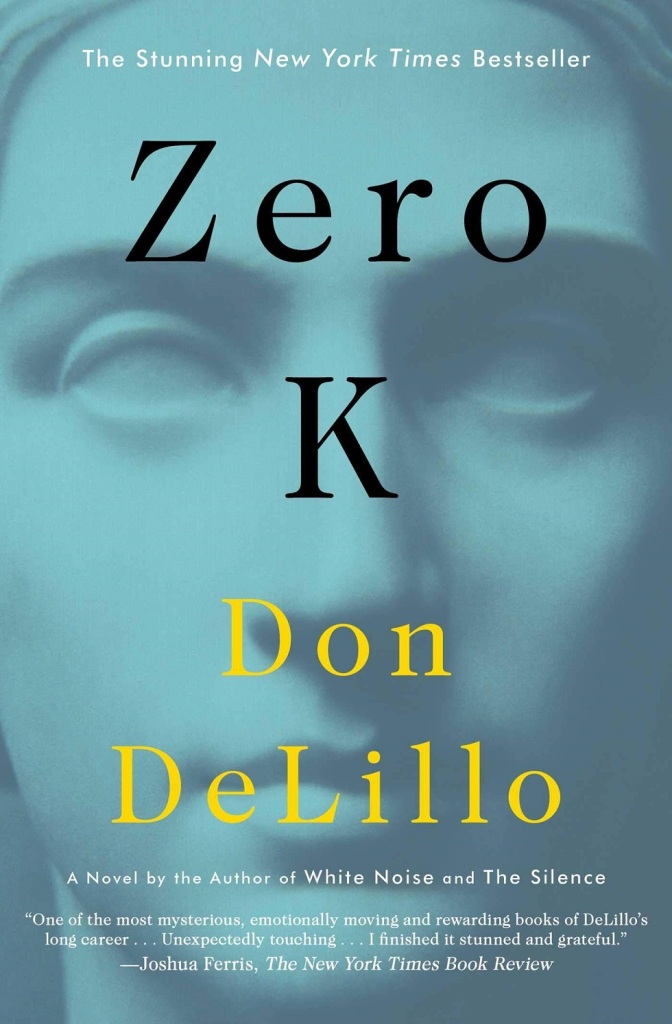
Book Review: Zero K by Don DeLillo

Book #243 of 2021:

Zero K by Don DeLillo

Theoretically, this is the story of a man saying goodbye to his ailing stepmother before she undergoes assisted suicide and cryogenic freezing (in the hope of being reawakened and cured at some unknown future date), and then later to his father when he follows in her footsteps. In actual practice, it’s a bizarre string of half-baked navel-gazing, in which the characters wander around issuing pseudo-intellectual declarations that don’t feel tied to any particular personalities and reflect on unrelated matters. A few things do happen, but not in a way that forms any coherent larger plot. And the limited action is secondary to all the empty dorm room philosophizing and random flashback memories, anyway.

One critical lens which I find valuable is to ask, what is the apparent intent of this work, and how does it succeed or fail towards that aim? What is the best possible version of the project, and what tweaks might help bring that in line? But I’d be flummoxed as the editor of a novel like this. Passages have no clear relation with one another or purpose in the narrative, the protagonist doesn’t really seem to be driven by anything or to ever interact with anyone interesting, and the questions that get raised aren’t generally treated as important enough to require answers. As a reader I hoped it would all tie together or build to some grand point by the end, yet it just never does. I don’t say this about too many books, but this feels like it’s been an utter waste of my time.

★☆☆☆☆

–Subscribe at https://patreon.com/lesserjoke to support these reviews and weigh in on what I read next!–

Find me on Patreon | Goodreads | Blog | Twitter

TV Review: The Good Fight, season 5

TV #68 of 2021:

The Good Fight, season 5

This series bounces back to a degree after its all-time low of the previous year, but I’m still not altogether vibing with its distinctive brand of wacky and surreal satire. The big idea this season is that people are taking civil suits before an unofficial neighborhood court, agreeing to be bound by the decisions of its arbitrator. Initially, the only weird thing — besides the fact that he’s played by Mandy Patinkin — is that the man is operating out of a copy shop warehouse and insisting on calling himself a judge, but matters steadily escalate until he’s starring in a theatrical reality show, hearing criminal cases that the police bring to him, sentencing guilty defendants to be held in a private prison, and ultimately inspiring copycat tribunals that may be even less tethered to any traditional sense of justice and the law.

It’s all a bit much, and it rarely serves the characters well. Better is the early focus on Kurt McVeigh’s likely involvement with a group of the January 6th rioters, a nice use of his problematic politics and an example of how the program can stay relevant despite Trump leaving office. It also continues to shine an important light on discussions of racism and privilege in our modern America, and it doesn’t stumble too hard over the departure of another two original cast members, Cush Jumbo and Delroy Lindo, in the very first episode (which faces the tricky situation of showing how the pandemic shutdown affected everyone at the firm without dwelling on the aftereffects the writers couldn’t have known about and that we’re obviously still living with today).

Overall, it’s the usual mixed bag. Apart from the Wackner and insurrection stuff, this run finally interrogates its own premise of putting a rich white lady at the head of a historically black business, and it transforms assistant-turned-investigator Marissa Gold into a lawyer because, well, why not at this point? (Honestly, I don’t mind at all. It’s a little out of left field, but Sarah Steele’s performance has always been one of the most earnest and engaging in this franchise, so more of her is seldom a problem.) New attorney Carmen Moyo kind of feels like simply Lucca 2.0 so far, and Jay has an experience of long-haul Covid that is intense at times yet undercut by his bizarre hallucinations of historical figures from Malcolm X to Jesus. Diane’s seeing one of Ruth Bader Ginsburg too, although hers doesn’t seem to be triggered by anything in particular.

That’s The Good Fight, folks! This spinoff has never aimed to be as grounded as its predecessor, and it cedes a lot of potential effectiveness as a result. There’s enough here to be worth watching for sure, but it just keeps blocking itself from ever rising to the level of some of its stronger component pieces.

[Content warning for antisemitism.]

★★★☆☆

Find me on Patreon | Goodreads | Blog | Twitter

Design a site like this with WordPress.com
Get started