Book Review: How Not to Get Shot: And Other Advice From White People by D. L. Hughley and Doug Moe

Book #232 of 2020:

How Not to Get Shot: And Other Advice From White People by D. L. Hughley and Doug Moe

The satire in this book is heavy-handed but warranted, laying out how the smug lectures given to black people like “don’t mouth off to the police” are a) contradictory, b) not followed by white folks, c) not anything a reasonable society should require, d) not actually effective at preventing harm, and e) essentially just politer ways of saying “don’t be black.” Comedian D. L. Hughley and his cowriter Doug Moe have come prepared with example after example of victims who were shot despite following all that advice, and although it’s tough to find a grim humor in the Black Lives Matter movement, the text does present a stark case for racism as a systemic problem that needs to be dismantled.

On the downside, some of the punchlines in this 2018 title already feel dated, and the arguments occasionally lash out in unfortunate directions. There’s a short bit near the end, for instance, where the authors claim that LGBT oppression isn’t as bad as antiblackness, in part because everyone has a gay loved one but white people don’t have any relatives of color. That’s a false point to begin with, and comparing the suffering of different marginalized groups doesn’t help either — or recognize the uniquely vulnerable population at the intersection of those communities. Hughley and Moe also use the transphobic expression “a man trapped in a woman’s body” as well as a few unnecessary slurs against other racial minorities. So it’s not a perfect read, especially given that it’s situated as a guide for the unwoke who may be less inclined to think critically about these issues.

★★★☆☆

–Subscribe at https://patreon.com/lesserjoke to support these reviews and weigh in on what I read next!–

Find me on Patreon | Goodreads | Blog | Twitter

Book Review: The Magnificent Monsters of Cedar Street by Lauren Oliver

Book #231 of 2020:

The Magnificent Monsters of Cedar Street by Lauren Oliver

This middle-grade adventure story has a nice anti-bigotry message, objecting to prejudice both against marginalized human groups and against the misunderstood creatures in the heroine’s care, but that’s somewhat muddled when the ultimate villain is revealed to be a monster himself. I also think the text overall is too exposition-heavy for my tastes, let alone those of a younger reader. (Literally the entire first 7% of the novel is spent just listing out encyclopedia entries about the different species before we have any reason to care about them!)

I’m frustrated by some contrived coincidences driving the plot too, as well as how self-contradictory the invented science is. One animal, for instance, is alternately described as being closely related to a chimpanzee, closely related to a monkey, and situated in an entirely separate taxonomic kingdom, which patently cannot all be true. I don’t need a book like this to be particularly realistic, but its flights of fancy should at least aim for internal consistency.

Finally, a plea to authors everywhere: don’t give your main characters such similar-sounding names as Cornelius and Cordelia. It’s cutesy, but too difficult to always distinguish between them when listening to the audiobook.

★★☆☆☆

–Subscribe at https://patreon.com/lesserjoke to support these reviews and weigh in on what I read next!–

Find me on Patreon | Goodreads | Blog | Twitter

Book Review: The Extraordinaries by TJ Klune

Book #230 of 2020:

The Extraordinaries by TJ Klune (The Extraordinaries #1)

I’ve gone back and forth on my rating for this YA superhero title, parts of which are definitely cute and fun and offer some delightful gay and ADHD representation. I have friends who justifiably adore it, but as a whole I just can’t give my full endorsement. First, for such a twist-heavy narrative, the plot feels far too telegraphed — I was able to call nearly all the major developments well in advance, plus a few further ones that I’ve now seen confirmed for the sequel — and while that seems somewhat like an intentional writing choice to create the sort of oblivious protagonist who won’t notice things right under his nose, it makes for a frustrating read that doesn’t endear me to the character. I don’t think I actually started enjoying this book until fairly late, after most of those poorly-kept secrets had finally been revealed.

More importantly, the hero’s dad is a police officer, and the novel goes out of its way to downplay or even celebrate his abuse of power on the job. The backstory is that he’s been demoted for punching a witness in anger, but saved from firing by his enabling coworkers who “had argued with Internal Affairs and the higher-ups, telling them in no uncertain terms that Detective Bell shouldn’t be dismissed, that he was an unmatched asset to the Nova City Police Department, and to lose him would mean losing someone who bled blue.” Elsewhere in the text, this man orders his son’s arrest for a minor infraction, and repeatedly jokes that he’ll have his gun ready when the boy’s romantic interest comes over for dinner. He and another cop also express as a punchline their apparently earnest desire to tase and mace the people who resist them.

To author TJ Klune’s credit, he has acknowledged in a blog post how harmful this uncritical portrayal of law enforcement brutality is, and vowed that the rest of the series will address the issue head-on. I’m still not sure if I’m willing to extend that trust to check out the next volume, but I do know my impression of this one is unchanged by the writer’s regrets. Although I wish this were simply a story about superpowers, secret identities, and clueless besties falling in love, the faults are too severe for me to set aside.

★★☆☆☆

–Subscribe at https://patreon.com/lesserjoke to support these reviews and weigh in on what I read next!–

Find me on Patreon | Goodreads | Blog | Twitter

Book Review: The Power That Preserves by Stephen R. Donaldson

Book #229 of 2020:

The Power That Preserves by Stephen R. Donaldson (The Chronicles of Thomas Covenant, the Unbeliever #3)

A suitably epic conclusion to this classic postmodern fantasy trilogy, bringing both its setting and its reluctant champion to the verge of apocalypse before pushing forward to a measure of redemption for each. This series is so distinctive within its genre for the protagonist’s relationship to the duties of worldsaving; although readers may come to believe in the Land by seeing it through other eyes, the self-styled Unbeliever insists it’s a dream till the end. Yet over the course of these three novels, he has shifted gradually in that understanding, such that what once seemed a seductive delusion threatening his sanity has been subtly transformed into an expression of his own attitude towards the beauty of life. By moving to oppose Lord Foul the Despiser in this final volume, Thomas Covenant in a sense is merely rejecting his own despair and embracing a reason to go on living.

The brilliance of this conceit is that it manages to work both inside and outside the framework of unbelief, telling a satisfying story whether we accept the magical realm as real for its denizens or not. Crucially, however, Covenant himself fully emerges in this book as uniquely positioned by his particular moral outlook as the only person who can possibly achieve victory there. Fantasy often operates on the level of allegory, but seldom does a character’s belief about that principle so plainly manifest to drive events — you can read Sauron in The Lord of the Rings as a metaphorical externalization of Frodo’s worst impulses, for instance, but it’s not as though the hobbit ever engages with the enemy in that fashion.

That’s a lot of critical analysis, and I do think it speaks to the care with which author Stephen R. Donaldson has crafted this narrative, but I again want to stress that this is also just a gripping adventure with indelible heroes in an exquisitely immersive domain. Reuniting with his giantish friend Saltheart Foamfollower, who is experiencing a spiritual crisis of his own, a weakened and weary Covenant sets out across the ravaged countryside to confront Foul directly and find a better answer than hatred to his crimes. I wish this plot had room to connect back with Lord Mhoram defending Revelstone from the Despiser’s armies, but both storylines embody a powerful message that fighting for what’s right is a meaningful pursuit in and of itself, regardless of the odds against that effort or even whether it ultimately succeeds.

(I’m cheating a bit here by having read Donaldson’s 1986 paper, “Epic Fantasy in the Modern World: A Few Observations,” in which he flatly states that he was writing the Covenant books to reject Jean-Paul Sartre’s definition of humanity as a futile passion. He notes too that his structure is an intentional inverse of Tennyson’s Idylls of the King, wherein an idealized vision for civilization is brought low by realistic human jealousies. If Arthur’s grand utopia was doomed by the petty people of Camelot, Donaldson would show how one bitter man could be elevated and redeemed by translation to an environment of loyalty and love. I take those cues from the writer on interpreting his work, but the themes are present nevertheless.)

Taken as a whole, this initial arc of the Thomas Covenant saga asserts that it’s okay to imagine more for ourselves, and that our most precious dreams have intrinsic value that’s worth preserving to the last, all with endearing actors in a landscape as lush and well-realized as Tolkien’s Middle-earth. The later sequels steer that concept in a few unexpected directions that don’t always succeed for me, but the overall series is a long-time personal favorite. It’s challenging and wonderful in equal parts that climb to a marvelous catharsis here, and I’ve frankly still never read anything else quite like it.

This book: ★★★★★

Overall series: ★★★★★

Individual rankings: 3 > 1 > 2

–Subscribe at https://patreon.com/lesserjoke to support these reviews and weigh in on what I read next!–

Find me on Patreon | Goodreads | Blog | Twitter

TV Review: The Office, season 3

TV #40 of 2020:

The Office, season 3

Another strong year for this classic workplace sitcom, delivering laughs that largely still stand up today and fun new developments to long-term character dynamics. If I have one complaint about this stretch of the series, it’s that it ends up feeling far less daring than it begins: although we open on Jim with a new cast at an entirely different branch and spend a decent amount of time splitting narrative attention across the two locations, that arc draws to a close with him right back where he started accompanied by only a pair of remaining newcomers. (Similarly, the later potential shake-up of a new job at corporate that could go to him or Michael ultimately takes a much safer route, dramatically speaking.) What seems initially like a bold experiment relapses into the former status quo, and the majority of the season plays out almost as though our erstwhile salesman had never left Scranton at all.

I say ‘almost’ because plot aside, this batch of episodes gets a lot of mileage out of the shifting interactions between Jim and Pam, each still clearly drawn to the other yet inadvertently hurtful at instances of offered vulnerability. The Office really earns Pam’s eventual line that the two of them could never get their timing right, and watching that tragedy play out in slow motion over the course of this run surely tugs on any shipper’s heart. It would have been all too easy for the writers to throw these lovebirds straight into a relationship after the preceding finale, and the riskier approach they adopt instead pays off with so many interesting further contours to an already poignant will-they-won’t-they. Karen, too, mostly manages to appear more than just a temporary romantic obstacle — or at least, she’s not so plainly wrong for Jim as Roy was/is for Pam — which makes it difficult to imagine a happy ending for everyone who deserves one.

But there are moments of triumph here too, and even at its most affecting, this is not a program ever prone to the maudlin. The scenes tend to carry a zippy energy that’s pretty far from the soul-sucking drudgery of the early show, and the reluctant coworkers are by now quite transformed into a TV found family, which helps soften the rougher edges of certain personality types. The comedy yields some enduring quotes, but the evolving social context of their delivery is the real reason to keep tuning in.

★★★★☆

Find me on Patreon | Goodreads | Blog | Twitter

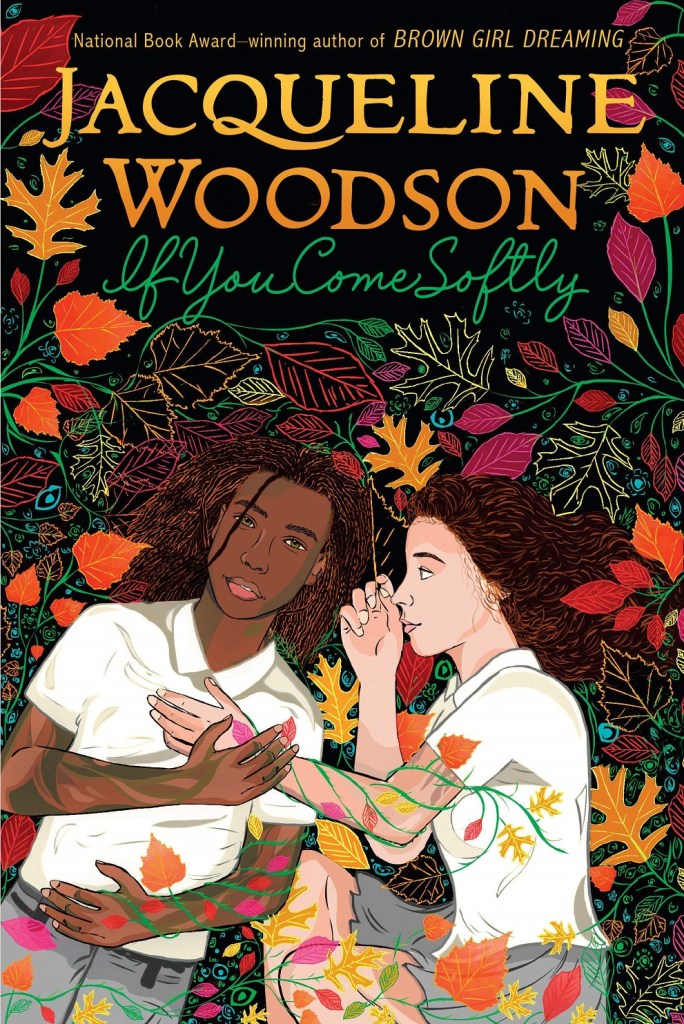
Book Review: If You Come Softly by Jacqueline Woodson

Book #228 of 2020:

If You Come Softly by Jacqueline Woodson (If You Come Softly #1)

Here’s a book like Bridge to Terabithia that’s almost impossible to discuss without spoilers, especially given the content warning that many prospective readers might appreciate. It’s a love story between two fifteen-year-olds, one a black boy and one a white Jewish girl, and it culminates with him being shot to death by officers who mistake him for a suspect they’re pursuing. We don’t spend a whole lot of time in the aftermath of that act, which creates a lack of closure that’s realistic for sudden violence but perhaps less satisfying in a work of fiction. It’s a short novel overall, and there are plenty of truncated plot threads that could have benefitted from having more space to wind down and resolve.

So I have mixed feelings about the project, but I do have to commend author Jacqueline Woodson for boldly tackling racism and police shootings in a title for young people first published in 1998. (It’s also possible that some of my concerns are addressed in her 2004 sequel.) I may have rolled my eyes when the teens fall for one another at first sight, but each is well-drawn as a character, and their writer is adept at presenting the microaggressions experienced by interracial couples and the tensions that can still exist in families who espouse openmindedness.

I just can’t shake the feeling that I would like all this better if it weren’t a tragedy, and I question whether giving the narrative that shape serves to perpetuate an ideology that relationships like mine are fated for unhappy endings.

★★★☆☆

–Subscribe at https://patreon.com/lesserjoke to support these reviews and weigh in on what I read next!–

Find me on Patreon | Goodreads | Blog | Twitter

Book Review: Good Economics for Hard Times by Abhijit V. Banerjee and Esther Duflo

Book #227 of 2020:

Good Economics for Hard Times by Abhijit V. Banerjee and Esther Duflo

There are some interesting recent studies in this text, and I appreciate the inclusion of data from India and other developing countries, but as a piece of popular economics writing, it sinks along three key dimensions. First, despite having just finished the book, I could not begin to tell you what it’s about. There is no clear thesis illuminating husband-and-wife authors Abhijit V. Banerjee and Esther Duflo’s discussion, and no particular framework they are trying to advance beyond better-informed government policy. Although progressive readers may see validation in the findings that anti-immigration actions, trade tariffs, and tax cuts for the wealthy apparently do not stimulate the economy, this is more of a loose collection of expert opinions than any cohesive argument.

On a second and related note, these writers complain about political polarization and widespread anti-intellectualism as generalities, but in case after case, the above pattern holds, with the field consensus overwhelmingly justifying leftwing positions. It seems to me that if one party or mode of legislative thought systematically ignores the science and another is generally in line with the best available knowledge, maybe the problem isn’t sectarianism in the abstract but rather that one sect of bad actors. Yet that conclusion is never reached within these pages, to the point where it almost feels like gaslighting when Banerjee and Duflo continue to bemoan how no one is listening to the economists.

And finally, there are a number of factual errors or misrepresentations that I’ve picked up on in this title, from details of the Y2K computer bug to the circumstances of Hillary Clinton’s infamous “deplorables” comment. I am not well-versed enough in the authors’ discipline to judge the overall accuracy of their scholarly analysis, but the issues that I’ve noticed lead me to suspect that the work hasn’t been duly fact-checked to the extent that it probably should have been. I don’t know that I can honestly trust the reporting here, which is frustrating when so much of it would otherwise support my personal politics.

★★☆☆☆

–Subscribe at https://patreon.com/lesserjoke to support these reviews and weigh in on what I read next!–

Find me on Patreon | Goodreads | Blog | Twitter
Book Review: The Guns of Avalon by Roger Zelazny

Book #226 of 2020:

The Guns of Avalon by Roger Zelazny (The Chronicles of Amber #2)

This 70s fantasy sequel is another fun sword-and-sorcery adventure across parallel worlds, but it’s rather less gripping than the series debut. Our demigod hero was no less superhuman in that previous volume, but as an amnesiac going up against his equally powerful siblings, he was effectively challenged in ways that aren’t available in a novel where Corwin has regained his faculties and is mostly off among mortals away from the family. Author Roger Zelazny also continues his sexist treatment of every female character, including one introduced as the protagonist’s teenage great-grand-niece, whom he subsequently sleeps with. No thank you!

These books are a product of their time and the state of the genre then, and they’re generally short enough to just roll with the swashbuckling and try not to worry about any bigger-picture flaws. But I still need a little bit more to the plot than we’re given here if I’m going to feel properly invested as a reader.

★★★☆☆

–Subscribe at https://patreon.com/lesserjoke to support these reviews and weigh in on what I read next!–

Find me on Patreon | Goodreads | Blog | Twitter

TV Review: Star Wars: The Clone Wars, season 3

TV #39 of 2020:

Star Wars: The Clone Wars, season 3

Another run of this CGI cartoon that strikes me as largely disposable for the wider franchise plot, although I assume the action sequences are exciting for younger audiences. The most interesting things this year are the complications that develop in the Dooku / Ventress relationship and a too-brief look at the young Wilhuff Tarkin, and these are more than offset by the filler episodes around them and that interminable arc on Mortis filled with portentous empty technobabble about the Force. I suppose there’s also potential in the new character of Savage Opress, but so far he hasn’t done much to make up for his incredibly groan-worthy name.

Part of the problem is that the first three seasons of the show are told in a jumbled-up order, which can work as a narrative approach when there’s emotional resonance across the different time settings, but here just feels scattered and prevents any meaningful stakes from arising. I’ve heard that the remainder of the series is much more linear in its storytelling, which can only be an improvement — because although this is still a program that I seldom mind, I rarely feel truly invested in it, either.

★★★☆☆

Find me on Patreon | Goodreads | Blog | Twitter

Book Review: Cemetery Boys by Aiden Thomas

Book #225 of 2020:

Cemetery Boys by Aiden Thomas

There’s a certain climactic reveal in this YA urban fantasy novel that I found disappointingly telegraphed from early on, but that’s honestly one of the only critiques I can make about it. What a refreshingly original story overall, populated with delightful personalities who ring with #ownvoices authenticity. Both debut author Aiden Thomas and their hero Yadriel are queer, trans, and Latinx, and those identities are built into the very foundations of the narrative, providing deeply affecting stakes at every turn. The plot sounds almost like Coco meets Maggie Stiefvater — a teen from a family of witches must solve a ghost’s murder before midnight on Día de los Muertos — but the protagonist is also struggling with relatives who won’t accept him as a boy and a growing crush on the dead kid he’s accidentally summoned to his side. (Yadriel’s fierce commitment to never out anyone is somewhat ridiculous when it comes to keeping Julian’s death a secret, but is still a really sweet character trait that encapsulates him completely.)

I love so much about that premise and how it plays out, especially how Thomas doesn’t take the easy shortcut of collapsing transphobia and villainy. Instead the hero faces frustrating challenges from well-meaning loved ones, whose biases are neither excused nor treated as the pure evil that exists elsewhere in the book. It’s a complex and moving portrait that lends important layers to the events that unfold, and allows the writer to ground their escapism as more than wish-fulfilment without ever growing too dour. Similarly, the text is able to discuss the trauma of deadnaming without actually doing so to Yadriel, a seemingly organic development that nevertheless feels quietly radical.

There’s something intensely affirming about all this, and I’m so happy for all the readers who will see themselves in these pages. I also have to highlight publisher Swoon Reads for hiring a nonbinary illustrator for the cover art of this project and a trans, Latinx, queer narrator for the audiobook. That’s a super cool move that further strengthens the quality of the production and emphasizes the company’s commitment to diverse storytelling, and I definitely intend to read more of their works as a result. Hopefully we’ll even get sequels to this one, for although the main storyline and the worldbuilding rules for brujx and spirits seem complete for now, there’s ample room in the setting for future volumes to explore.

[Spoiler alert: This is almost a reverse content warning, but this title utterly subverts the ‘bury your gays’ trope in the end, giving its star-crossed couple the well-deserved happily-ever-after that I never could have expected. I am just so charmed, through and through.]

★★★★★

–Subscribe at https://patreon.com/lesserjoke to support these reviews and weigh in on what I read next!–

Find me on Patreon | Goodreads | Blog | Twitter

Design a site like this with WordPress.com
Get started