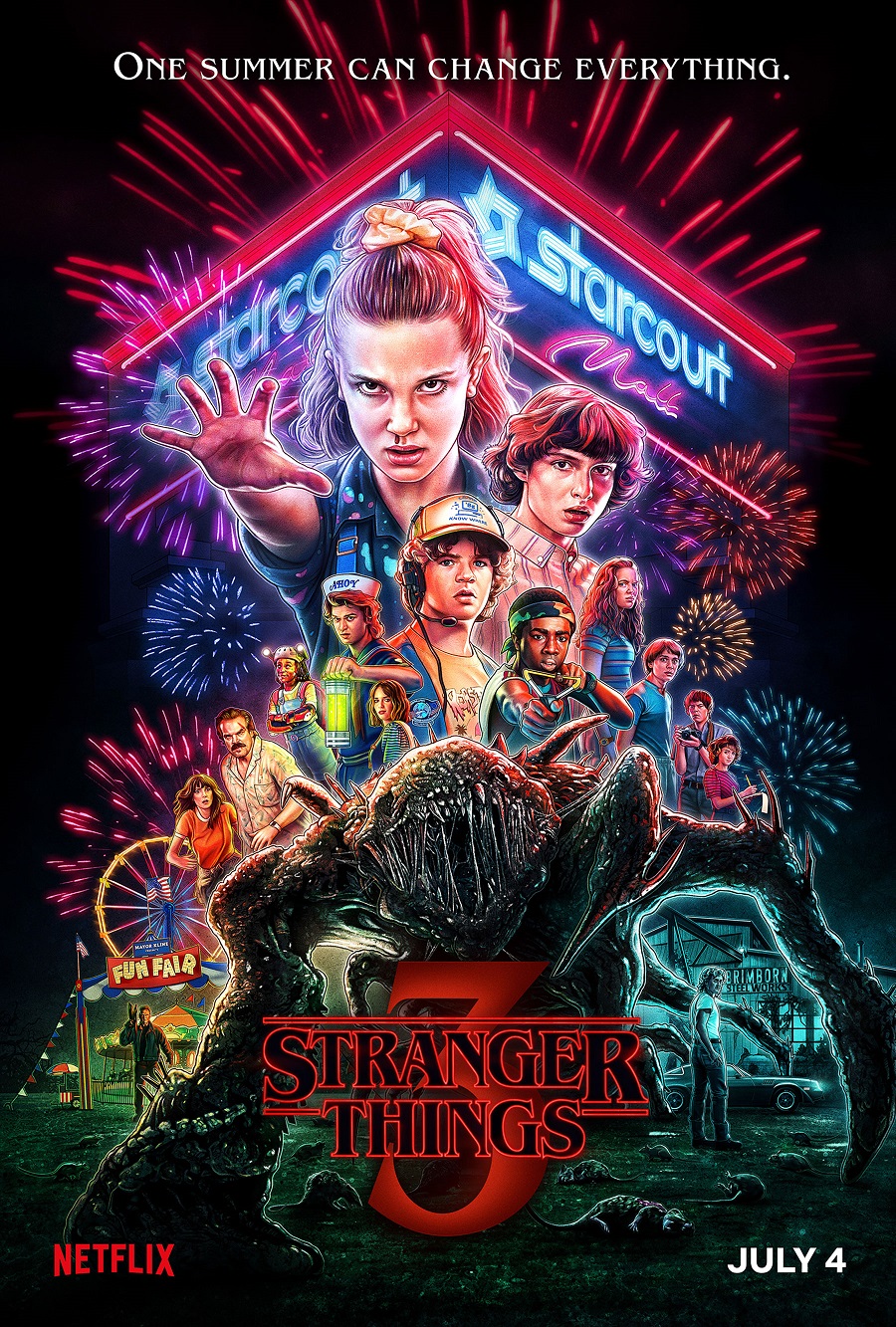
TV Review: Stranger Things 3

TV #30 of 2019:

Stranger Things 3

My biggest issue with this series as a whole is its tendency to fracture the narrative into engaging yet isolated small-group subplots that never intersect much with one another. And that’s definitely on display in this third outing, which is especially rough at the beginning before those disparate storylines have really taken off. (Eleven and Max’s new friendship at least offers some great individual scenes, but the boys except Dustin are pretty useless for basically the entire season.) Luckily matters converge more at the end of Stranger Things 3, and the returning pastiche of 1980s horror incorporates the new DNA of red-scare action blockbusters from that era fairly seamlessly.

Is it goofy as heck? Absolutely. This has always been a show where everyone is quick to accept some frankly ludicrous developments, and it’s especially hard for me to buy that extensive underground Russian base after seeing Better Call Saul so meticulously carve out Heisenberg’s future meth lab this past year. But if you can suspend your disbelief enough to get on the level of something like The Goonies as you watch this program, it’s overall a fun time with a game cast and some terrific character dynamics. The latest installment expands the mythology and avoids feeling like just a retread of what we’ve already seen, ably navigating the transition of its younger heroes growing up and shouldering more mature concerns. It pushes forward like all the best sequels do, and leaves me eager to see what’s next.

★★★★☆

Find me on Patreon | Goodreads | Blog | Twitter

TV Review: iZombie, season 5

TV #29 of 2019:

iZombie, season 5

iZombie has been a bit lifeless for a while now, and it finally shambles to a rest here. I hate to say it about a series that I once loved, but the last season of this zombie-cop comedy is just awful. The case-of-the-week stuff occasionally still delivers, but the larger plot developments are simultaneously contrived and poorly-developed, and no one’s characterization resembles a believable, motivated response to them at all — let alone a continuation of who these people have been in previous years.

Season 4 was already a big step down from what came before, but this final run of episodes has somehow gotten even worse. Maybe creator Rob Thomas and his production team were too focused on their recent relaunch of Veronica Mars? Whatever the reason, there are so many abortive storylines and moments played for unearned pathos that I almost feel as though I’m watching late-stage Dexter again. As with that program, I now have to caution prospective viewers to quit around the midpoint of what seems like a great show. You may think the narrative yet shows signs of life, but in fact, it’s already dead.

This season: ★☆☆☆☆

Overall show: ★★★☆☆

Season ranking: 1 > 2 > 3 > 4 > 5

Find me on Patreon | Goodreads | Blog | Twitter

Book Review: H is for Hawk by Helen Macdonald

Book #139 of 2019:

H is for Hawk by Helen Macdonald

Written in the wake of her father’s death, this 2014 memoir from author Helen Macdonald is an unsettling and complicated account of how she felt drawn to train a young goshawk as a way of processing her emotions. Alongside this personal narrative, she also shares insights from her long-held interest in falconry as well as facts from the tortured life of writer T. H. White, who famously once raised the same type of bird and poured out his own anguish into his writing about it.

It’s a very strange read, but one that’s educational and often piercingly poignant. Early on, Macdonald notes that people in grief invest meaning in happenstance, and that’s a theme that proves itself at length as she grapples with the hawk as the sole lens with which to consider her loss. Adopting a wild animal is not how most readers would ever think to mourn, but the poetic quality of her writing elevates the specific to the universal to make it feel deeply relatable nonetheless.

★★★★☆

Find me on Patreon | Goodreads | Blog | Twitter

TV Review: Jane the Virgin, season 5

TV #28 of 2019:

Jane the Virgin, season 5

What a beautiful send-off to a beautiful show. Jane the Virgin has gone down a few narrative dead-ends over the years, but its final season leans strongly into the character relationships that have always made its telenovela twists and heightened magical realism elements land so well. There are loving callbacks to moments from across the show’s rich history, and a steady progression to a wonderful ending for this story. I will miss this program and its fierce dedication to Latinx representation, but it’s a great example of a TV series wrapping up on its own terms. I may just need to rewatch all 100 episodes with my daughter when she’s old enough.

This season: ★★★★★

Overall series: ★★★★☆

Season ranking: 1 > 5 > 4 > 3 > 2

Find me on Patreon | Goodreads | Blog | Twitter

Book Review: Jade City by Fonda Lee

Book #138 of 2019:

Jade City by Fonda Lee (The Green Bone Saga #1)

Let me start with the good and say that I love the setting of this book. It doesn’t offer the most fleshed-out worldbuilding, but it’s the rare fantasy story told in a place that’s not our own yet has comparable levels of technology. (The cartoon Avatar: The Legend of Korra is the only other example that comes to mind, although Brandon Sanderson has talked about someday writing a Mistborn sequel along those lines as well.) Specifically, this fictional civilization seems to be at twentieth-century levels of development, with airplanes, machine guns, cassette tapes, and land-lines but no internet or cell phones. Adding a magical element to that feels new and exciting for this genre, as do the Asian-inspired culture and characters.

As for the plot, that’s a more straightforward affair of rival crime syndicates, with some predictable Godfather touches of the next generation getting reluctantly drawn into the family business. The gangster protagonists are not especially engaging — which makes the requisite betrayals and deaths not land so well — but as vehicles to deliver the overall mood of the piece, they do just fine. I’ll probably check out the next volume of this series, in hopes that it improves on this front while continuing to present such a distinctive backdrop for the action.

★★★☆☆

Find me on Patreon | Goodreads | Blog | Twitter

Book Review: Midnight in the Garden of Good and Evil by John Berendt

Book #137 of 2019:

Midnight in the Garden of Good and Evil by John Berendt

An evocative travelogue of late-twentieth-century Savannah that could use greater structure throughout. The introduction of a certain true crime element around the midpoint adds some focus to the back half, but before then I kept wondering where this narrative was going. That’s frankly a baffling artistic decision, especially given author John Berendt’s admission in the afterword of my edition that he invented an early scene with the murder victim and did not actually arrive in Georgia until the man was already dead and his killer in jail. If the book had instead been openly framed as the story of that shooting and its aftermath, I think I would have enjoyed it more.

Even with these issues, however, this is a very well-written ‘nonfiction novel,’ and I love all the characters that Berendt has managed to capture on the page. His empathic and honest portrayal of black drag queen Chablis is particularly striking, as is the way the author brings this whole setting and its society to life for us. I only wish he could have presented it in a manner to better support the topics that seem to ultimately interest him.

[Content warning for antisemitism, homophobia, and racism, including slurs.]

★★★★☆

Find me on Patreon | Goodreads | Blog | Twitter

Book Review: Cribsheet: A Data-Driven Guide to Better, More Relaxed Parenting, from Birth to Preschool by Emily Oster

Book #136 of 2019:

Cribsheet: A Data-Driven Guide to Better, More Relaxed Parenting, from Birth to Preschool by Emily Oster

One of the major challenges facing new parents is the sheer over-abundance of advice out there — which has admittedly always been somewhat of an issue, but is exacerbated by the explosion of digital resources over the past several decades. For almost any potential decision about how best to raise your child, apparent experts and passionate advocates on every side are just a few keystrokes away, and it’s a real challenge to sort out conflicting recommendations, especially in the sleep-deprived haze of life with an infant.

The strength of this 2019 book from economist Emily Oster, then, is that it’s not just another set of tips that might contradict someone else’s, but rather an attempt to impose a science-based framework on the overall subject matter. Assessing the existing data, the author illuminates parenting topics where there’s clear evidence for one strategy over another (e.g. “cry it out” methods of sleep training are effective and show no short-term or long-term harm), where no quality research on the question exists (e.g. the effects of screentime are still largely unknown, despite what anyone tells you), or where it’s largely a matter of individual family choice (e.g. the potential medical benefits and risks of newborn male circumcision are both vanishingly small).

Alongside these conclusions, Oster guides her readers on Bayesian priors, opportunity cost, risk comparison, and other economic tools for critical thinking so that we can evaluate further inflection points ourselves. She also helpfully provides a bullet-point summary at the end of every chapter, either for parents who don’t have time to read the extended reasoning or for those who already have but want to quickly review later on. I feel like I’ll be in that latter category myself, so although I listened to this title as a digital audiobook from my library, I’m glad to have been gifted a physical copy I can keep around as a reference. (Thanks, Aunt Doreen!)

★★★★☆

Find me on Patreon | Goodreads | Blog | Twitter

Book Review: The Impeachers: The Trial of Andrew Johnson and the Dream of a Just Nation by Brenda Wineapple

Book #135 of 2019:

The Impeachers: The Trial of Andrew Johnson and the Dream of a Just Nation by Brenda Wineapple

There’s no such thing as a truly neutral history, but author Brenda Wineapple has assembled a fine presentation of the facts surrounding America’s first presidential impeachment attempt. She does not shy from calling Andrew Johnson a white nationalist, or from showing how he was a racist even by the standards of his day. (Actual quote from our 17th president, far from the most shocking in this text: “This is a country for white men, and by God, as long as I am president it shall be a government for white men.”) She explains how Johnson ignored congress and the courts and was quick to let rebel states back into the union with no change in leadership or provisions to ensure equality for the formerly enslaved. But she also details at great length the agenda of those legislators working against him, potential cases of bribery on both sides, and how contemporary observers largely understood impeachment as a partisan exercise and worried over the precedent it would set.

In fact, my biggest issue with this book is that it sticks mostly to the Reconstruction era and sidesteps how later historians have presented the matter quite differently. The prevailing narrative on this topic has generally framed ‘the impeachers’ as overzealous and bloodthirsty, with poor Andrew Johnson seen as a beleaguered man trying to carry out Abraham Lincoln’s vision for a healed nation. The more complex picture in Wineapple’s work is an important pushback against that interpretation, but it rarely announces itself as such, and readers who lack that context might miss how revolutionary and controversial this volume could be.

Perhaps surprisingly in a 2019 publication, the author also leaves out any question of modern parallels to a pugnacious, norm-violating president often accused of abusing the power of the office. Despite conveying the ad hoc nature of the Johnson impeachment trial and the frenzied dispute over what precisely the constitution means by high crimes and misdemeanors, she’s ultimately agnostic on whether the process was fair and doesn’t much discuss the implications for future attempts. It’s overall less exhaustive than it could be, although still an admirable narrow look at the country’s first impeachment itself.

[Content warning for the use of the n-word in historical quotations.]

★★★☆☆

Find me on Patreon | Goodreads | Blog | Twitter

Book Review: Witchmark by C. L. Polk

Book #134 of 2019:

Witchmark by C. L. Polk (The Kingston Cycle #1)

A charming story, both for its Edwardian-flavored fantasy setting and for the tender gay romance at its heart. The worldbuilding details of bicycle traffic and early electric lights stop just short of twee, but my favorite is possibly that there’s no signs of homophobia in this society — matched by no real drama in the central relationship beyond the practical considerations involved with loving a supernaturally beautiful angel. The characters are allowed to just be sweet with one another as they team up to investigate a rapidly expanding mystery.

That main plotline falters a bit, and I think debut author C. L. Polk sometimes loses track of who knows what information when. There’s an interesting class dynamic of wealthy sorcerers using their magic openly while poor witches get locked in asylums for exhibiting the same powers, but the narrator still seems to fear this fate long after he’s been openly identified as a runaway scion of a major family. There are also some thematic considerations of slavery and battlefield trauma that get somewhat lost in the shuffle as the novel progresses.

So it’s not exactly a flawless work, but it’s still a precious and cozy start with a lot of promise ahead. I’ll be reading on, for sure.

★★★★☆

Find me on Patreon | Goodreads | Blog | Twitter

Design a site like this with WordPress.com
Get started