Book Review: Henry IV, Part 1 by William Shakespeare

Book #183 of 2017:

Henry IV, Part 1 by William Shakespeare

The plot of this Shakespearean history is a trifle thin, detailing only a sliver of England’s War of the Roses, but we’re mostly here for the humor, which offers more laughs than some of the bard’s actual comedies. The most famous bits involve Prince Hal’s childish antics with Falstaff before he begins to grow up and take on more responsibility, but his rival Hotspur constantly deflating Welsh king Owen Glendower’s mystical airs is a standout scene as well. I’m glad I read this, although it’s not going to go down as one of my favorites.

★★★☆☆

Find me on Patreon | Goodreads | Blog | Twitter

Book Review: The Science of Game of Thrones: From the Genetics of Royal Incest to the Chemistry of Death by Molten Gold – Sifting Fact from Fantasy in the Seven Kingdoms by Helen Keen

Book #182 of 2017:

The Science of Game of Thrones: From the Genetics of Royal Incest to the Chemistry of Death by Molten Gold – Sifting Fact from Fantasy in the Seven Kingdoms by Helen Keen

A fun little pop science book with a ridiculously long title, offering nuggets of learning all vaguely related to the TV show Game of Thrones. The topics range all over the place – the section on dragons alone discusses what we know about the flight patterns of ancient pteranodons, the breeding habits of komodo dragons, and how long eggs of any species can go without hatching – but it’s all entertaining and informative, and the material is definitely elevated by author Helen Keen’s sense of humor. There are spoilers through the sixth season of the HBO show, but any reader who’s caught up to date will learn and laugh plenty.

★★★☆☆

Find me on Patreon | Goodreads | Blog | Twitter

Movie Review: The Room (2003)

Movie #15 of 2017:

The Room (2003)

Honestly, what is there left to even say about this awful movie at this point? No matter what you’ve heard, I guarantee you, the reality is even worse than that. It’s such an entertaining trainwreck to watch, though. Fun personal fact: I watched this movie for the first time back in 2015, just a few hours before I proposed to my wife. (I guess its clunky warning against trusting your closest loved ones somehow wasn’t enough to sway me!) I don’t even know whether it’s actually good enough to merit this generous two-star rating, but the rewatch value should probably count for something.

★★☆☆☆

Find me on Patreon | Goodreads | Blog | Twitter

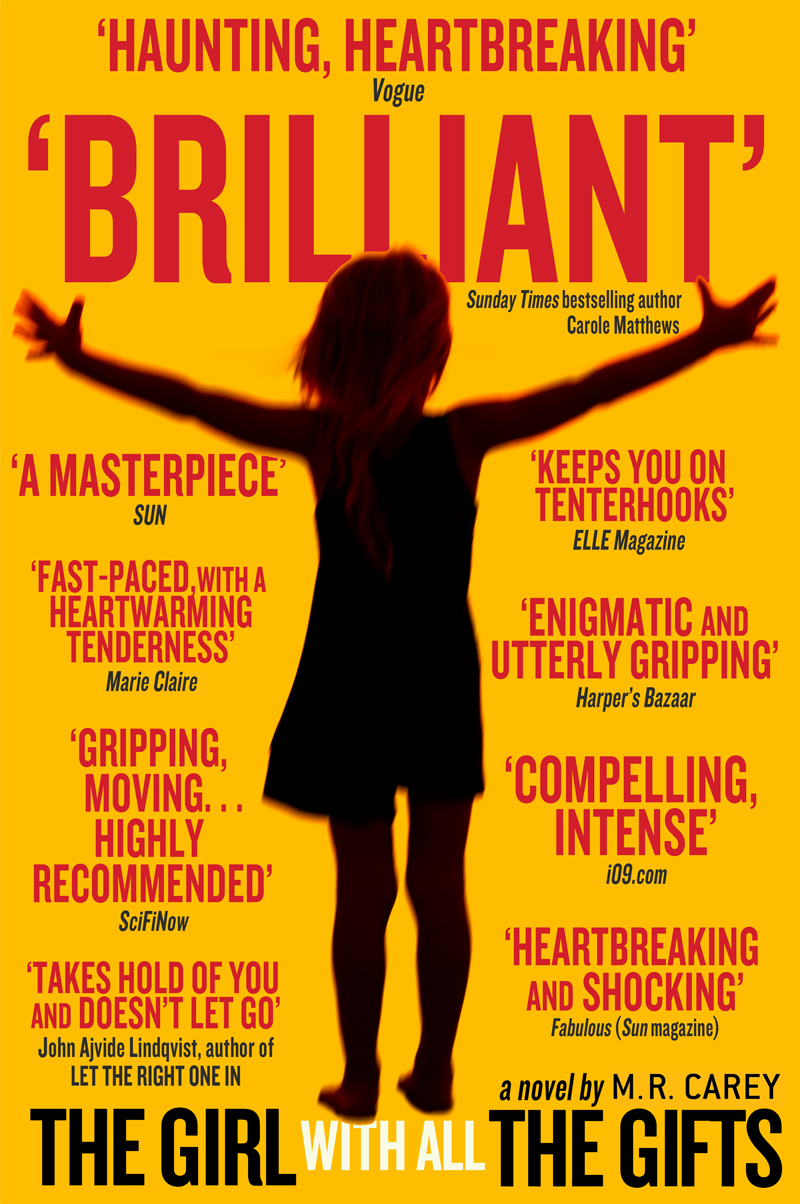
Book Review: The Girl with All the Gifts by M.R. Carey

Book #181 of 2017:

The Girl with All the Gifts by M.R. Carey

The setup to this book resembles Never Let Me Go, which similarly puts children in a bizarre setting with evasive caretakers who encourage them to accept everything as normal. But whereas that novel frustrated me by dragging out its reveal for almost the entire book, this one establishes the facts very early on: it’s set a couple decades after a zombie outbreak has upended society, and the children are infected individuals being studied in a carefully controlled quarantine environment. Melanie is a particularly talented young girl, but if not for her teachers’ regular chemical baths to hide their scent, the fungal infection would have her at their throats every time they take off her restraints.

Zombie stories told largely from the undead point of view are still relatively rare, and it’s even less common to find one that does so for pathos rather than comedy. But Melanie’s nature is achingly rendered in the language of an addict resisting a fix that she doesn’t want to want, and her struggle to determine what she is and where she fits in is very powerful. In addition to the great character work, the thriller that unfolds around Melanie is taut and suspenseful, presenting many classic zombie tropes in a way that still feels fresh. And while I didn’t even come close to predicting the ending, it was really the perfect way for this story to conclude.

★★★★★

Find me on Patreon | Goodreads | Blog | Twitter

Book Review: Perelandra by C. S. Lewis

Book #180 of 2017:

Perelandra by C. S. Lewis (The Space Trilogy #2)

This was a much more overtly religious book than Out of the Silent Planet, but I liked how the core of the story was essentially just a human arguing with a demon in the Venusian Garden of Eden. Lewis is skilled at conveying a worldview that’s alien and yet still recognizably (proto-)Christian, and it’s fun to see arguments for and against original sin presented through that lens. I just didn’t care as much for the end of the story, when the hero is moved to physically attack the demon rather than continue his efforts to outreason it.

★★★☆☆

Find me on Patreon | Goodreads | Blog | Twitter

Book Review: Wild Seed by Octavia E. Butler

Book #179 of 2017:

Wild Seed by Octavia E. Butler (Patternist #1)

Anyanwu is an African shapeshifter who has survived for centuries by healing all physical damage and keeping her body young. She thinks there’s no other person remotely like herself until she meets Doro, a man millennia past his own natural lifespan but whose consciousness moves on to take over a new host every time his current body dies. The two characters are alternately drawn to and repelled by one another, and I really loved the Magneto / Professor X interplay between them and their drastically different visions of their relationship to the rest of humanity. (Doro has grown to view people as eugenics subjects that he can selectively cross-breed to foster other strange abilities, whereas Anyanwu sees herself primarily as a healer and a matriarch to her extensive family of descendants.)

This first book in Octavia Butler’s Patternist series is full of her trademark reflections on the fluidities of race, gender, power, and blended families, and it’s a fascinating exploration of how the line between enemy and friend starts to blur when you’re the only two humans who live on through the centuries.

★★★★☆

Find me on Patreon | Goodreads | Blog | Twitter

Book Review: Emperor Mage by Tamora Pierce

Book #178 of 2017:

Emperor Mage by Tamora Pierce (The Immortals #3)

This third novel in Tamora Pierce’s Immortals quartet is the first one that I’ve felt approached the quality of the other books I’ve read in her wider Tortall series. The main character is still absurdly overpowered – she’s already able to magically communicate with, befriend, and transform herself into any animal she meets, and now she’s able to reanimate and command their skeletons as well – but the court intrigue plot gives her less of an outlet to use these abilities. She’s forced instead to think her way past the diplomatic obstacles of a peace summit, and the story is stronger for this restriction. I’m still not all that invested in her overall arc or her weird sexual tension with her much older tutor, but this is a very promising step.

★★★☆☆

Find me on Patreon | Goodreads | Blog | Twitter

TV Review: The Grinder, season 1

TV #36 of 2017:

The Grinder, season 1

I have such a soft spot for this silly little show about an actor convinced he can practice law at his brother’s firm just because he used to play a lawyer on TV. It’s just so rich in character-driven humor and meta-commentary on TV show plots, and the serialized storytelling gets pretty ambitious for a sitcom like this. It only ran for one season last year, but this is already my second time watching all the way through. The first time, I gave it the following review:

The Grinder is pretty funny as a sitcom, but it’s absolutely amazing for the meta-commentary it delivers on the TV industry. (It’s also impressively serialized for a half-hour comedy show.) It lovingly pokes fun at the genre tropes of legal dramas like The Good Wife, by telling the hilarious story of a TV actor leaving his hit legal drama to go practice law with his brother, a real lawyer. And I mean, I’m in favor of anything that gives Natalie Morales work. Unfortunately, as with her earlier show The Middleman, The Grinder was canceled way before its time.

★★★★☆

Find me on Patreon | Goodreads | Blog | Twitter

TV Review: Game of Thrones, season 7

TV #35 of 2017:

Game of Thrones, season 7

All in all, this is probably one of the weakest seasons of Game of Thrones. As cool as it is to see long-anticipated developments finally happening – and it really is cool, don’t get me wrong – it’s a little disappointing how many characters have developed “plot armor,” aka the seeming ability to endlessly escape deadly situations due to narrative importance. This is all the more jarring since GoT first established itself as a show where no one was ever truly safe, no matter their apparent status as a main character. But any time someone escapes from mortal peril now, I have to imagine that their personal story arc must not be done yet, and that there’s something particularly important the writers are saving them for. It’s not like every single character in a cast this massive is going to get a tidy resolution before the end of the show, but with only 6 episodes left at this point, plot armor increasingly feels like the only explanation for some people’s continued survival. Plus, as many other viewers have observed, the travel logistics in this world no longer make any sense, and it definitely weakens the storytelling further when characters can suddenly whiz around all over the map on a whim.

The finale did a lot to rehabilitate some of these concerns, but it took some really shaky storytelling and narrative shortcuts to get there. With a rumored delay until 2019 for the final season to air, I really hope the writers spend more time ironing out a good story rather than just relying on spectacle to coast through to the finish line as they largely did here.

★★☆☆☆

Find me on Patreon | Goodreads | Blog | Twitter

Book Review: The Yiddish Policemen’s Union by Michael Chabon

Book #177 of 2017:

The Yiddish Policemen’s Union by Michael Chabon

In the late 1930s, President Franklin Roosevelt rejected a government proposal to establish a settlement for Jewish refugees within America’s Alaskan Territory. The U.S. instead largely blocked Jewish immigration, and ultimately over six million European Jews were killed in the Holocaust.

Author Michael Chabon takes these historical facts and asks us to consider what would have happened if the Slattery Report proposal had been instituted after all, and if four million Jews had been able to escape the Holocaust and create a new home for themselves and their descendents in Alaska. It’s a heartbreakingly beautiful idea, even with Chabon’s best efforts to show how this new Jewish homeland would still be no paradise more than half a century into its existence. Our entry into this world is a jaded homicide detective, trying to solve one last murder case before America officially revokes the status of the Alaskan settlement and makes its inhabitants refugees once more, but it’s still dazzling to see so many Jewish characters who could never have been born in reality, as well as the uniquely Jewish character that this society has developed.

On some level all of this is a fictionalized dramatization of our own world’s struggles with notions of Israel, Judaism, and colonial statehood, wrapped up in a pretty good detective story to give the novel some characters and plot along with its worldbuilding. But it’s that world that really tugs at the reader, allowing us to dream of what could have been, if only America had lived up to its ideals as a land of immigrants instead of largely abandoning Jewish refugees to their fates.

★★★★☆

Find me on Patreon | Goodreads | Blog | Twitter

Design a site like this with WordPress.com
Get started