Movie Review: War for the Planet of the Apes (2017)

Movie #11 of 2024:

War for the Planet of the Apes (2017)

[Edited version of my original review from 2017.]

When I first came home from seeing this in theaters, I noted that it was “probably the best Planet of the Apes movie ever made.” Having had seven years to sit with that assessment, and having just spent the last week rewatching all nine of the existing films in the lead-up to catching a matinee of the new one for my birthday tomorrow, I can now categorically double-down on that claim. This is the Apes movie, folks. I love the 1968 original and the 2011 reboot too, but War is really in a class of its own.

Obviously it builds on everything that the franchise had previously established in terms of worldbuilding lore and Caesar’s characterization, but I think an audience could basically start here and still follow along (and be blown away) just fine. The script establishes itself with an immediate confidence, despite jumping several years from the seeming cliffhanger end of the preceding feature, and from there all the pertinent backstory is delivered naturally as it becomes relevant. In fact, I would say that the weakest part of this title is how disconnected it feels to its direct predecessor — we’ve skipped over the Colonel and Caesar’s initial encounter(s) to find them already mortal enemies, and there’s no sign or mention of Malcolm and his fellow human allies from Dawn (which likewise summarily dropped Will and Caroline from Rise). That’s especially jarring when you watch through the films in quick succession.

But this is Caesar’s story overall, and it serves him well by sending him off on a bitter dig-two-graves revenge narrative, only for his arc to finally come back around to his roots as a Moses figure for his people at the journey’s end. As a protagonist, he’s offset by Woody Harrelson as the unhinged military leader — the chimpanzee’s Kurtz in their cross-species dystopian take on Apocalypse Now — providing electrifying scenes together and the first truly worthy villain for this series since the days of Dr. Zaius.

Even outside of those opposing primal personalities, this film is a gorgeously-shot snow-covered post-apocalyptic western mashed up with a war movie – which doesn’t mean we’re subjected to endless combat maneuvers, but rather to a personal tale suffused in the anguish of sustained warfare with thoughtful treatment of occupying forces, collaborators, POW labor camps, and so much more. Yet even with all that heaviness, the comedy lands nicely too, tapping into a sense of humor that we haven’t really seen in this franchise since Escape in 1971. And the plot meanwhile feeds lightly into the context of the original Charlton Heston piece, in that the apes continue to develop their powers of speech while the dwindling remnants of human civilization have begun losing theirs. There’s even a plausible link to the “alpha and omega” mutant cult of Beneath and Battle, though thankfully without the accompanying campiness.

I’m so excited to see how Kingdom of the Planet of the Apes brings this setting forward even further — reportedly by centuries, to a time when Caesar’s name has passed into legend — and the rest of the era that I’m sure is being planned to follow. There’s still plenty of ground left to cover before the Icarus arrives, but I’ll take this opportunity to sing the praises of Andy Serkis and his supporting team of motion-capture animators, who have elevated this old science-fiction saga to new heights over the course of their modern trilogy. Take a deserved rest, king. Apes together strong.

[Content warning for gun violence, suicide, torture, and gore.]

★★★★★

Like this review?
–Throw me a quick one-time donation here!
https://ko-fi.com/lesserjoke
–Subscribe here to support my writing and weigh in on what I read next!
https://patreon.com/lesserjoke
–Follow along on Goodreads here!
https://www.goodreads.com/user/show/6288479-joe-kessler
–Or click here to browse through all my previous reviews!
https://lesserjoke.home.blog
Movie Review: Dawn of the Planet of the Apes (2014)

Movie #10 of 2024:

Dawn of the Planet of the Apes (2014)

[Edited version of my original review from 2017.]

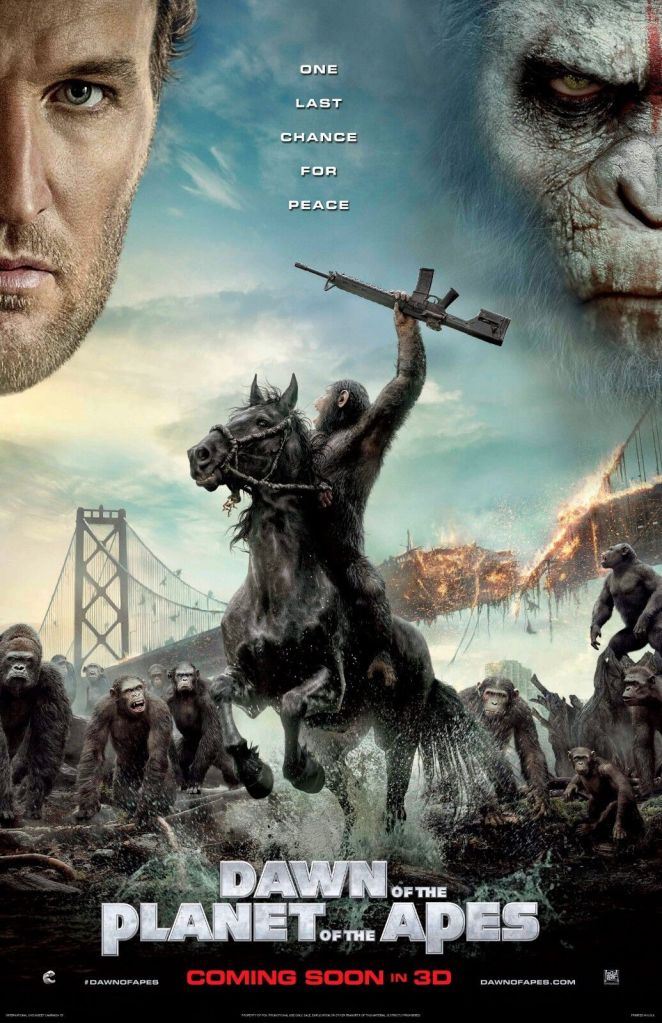
Still a very strong picture, but not quite as good as Rise in my personal opinion. This sequel is the first time that the modern Apes series goes fully post-apocalyptic, but we’ve jumped forwards ten years, and there’s not a whole lot of worldbuilding for how ape and human society alike have changed over that span. The human characters are likewise pretty thinly-sketched compared to Will and his father in the last film, with both Gary Oldman as the primary villain and Keri Russell in the middle of her Americans era getting frustratingly wasted here. The ending too leaves a lot up in the air for the next movie to theoretically resolve — though it ultimately doesn’t — resulting in this one feeling somewhat adrift between two superior entries. (A string of short web films and a pair of tie-in novels by Greg Keyes are intended to bridge those canon gaps, but I’d imagine most audiences aren’t even aware of them.) And finally, as a big fan of the franchise, I can’t help but notice how much this title remixes key elements from Battle for the Planet of the Apes, like agitators on both sides ruining the chance for peace and Caesar’s belated realization that his species can be just as cruel as humanity.

Nevertheless, it uses those familiar pieces well, and is overall a compelling immediate story in its own right (if rather inelegantly named). The decision to tell much of the dialogue through subtitled ape sign language gives it a radically different feel from its 2011 predecessor, which presented an extraordinary amount of character and plot information through nonverbal visuals alone. In contrast to the humans, the apes around Caesar seem much more fleshed-out this time thanks to how much more they can communicate to one another / us. And even though the script ends on an apparent cliffhanger with the incoming military forces, the central conflict between the human settlers and their ape neighbors is well-told with legitimate motivations on all fronts. While I do think their individual characterizations could be deeper, I appreciate that the various antagonists are basically reasonable people who care for their loved ones, and that the production goes out of its way to humanize (/chimpize?) them all.

At 130 minutes of runtime — 25 longer than Rise — matters could stand to be more propulsive, but it’s hard to argue with the striking images like apes on horseback firing machine guns, a gas station reclaimed by woods, or Koba’s deceptive minstrel performance for the human guards. This probably ties with Battle for the single most forgettable Apes installment, but in the moment, it’s solid enough.

[Content warning for gore.]

★★★★☆

Like this review?
–Throw me a quick one-time donation here!
https://ko-fi.com/lesserjoke
–Subscribe here to support my writing and weigh in on what I read next!
https://patreon.com/lesserjoke
–Follow along on Goodreads here!
https://www.goodreads.com/user/show/6288479-joe-kessler
–Or click here to browse through all my previous reviews!
https://lesserjoke.home.blog

Movie Review: Rise of the Planet of the Apes (2011)

Movie #9 of 2024:

Rise of the Planet of the Apes (2011)

[Edited version of my original review from 2017.]

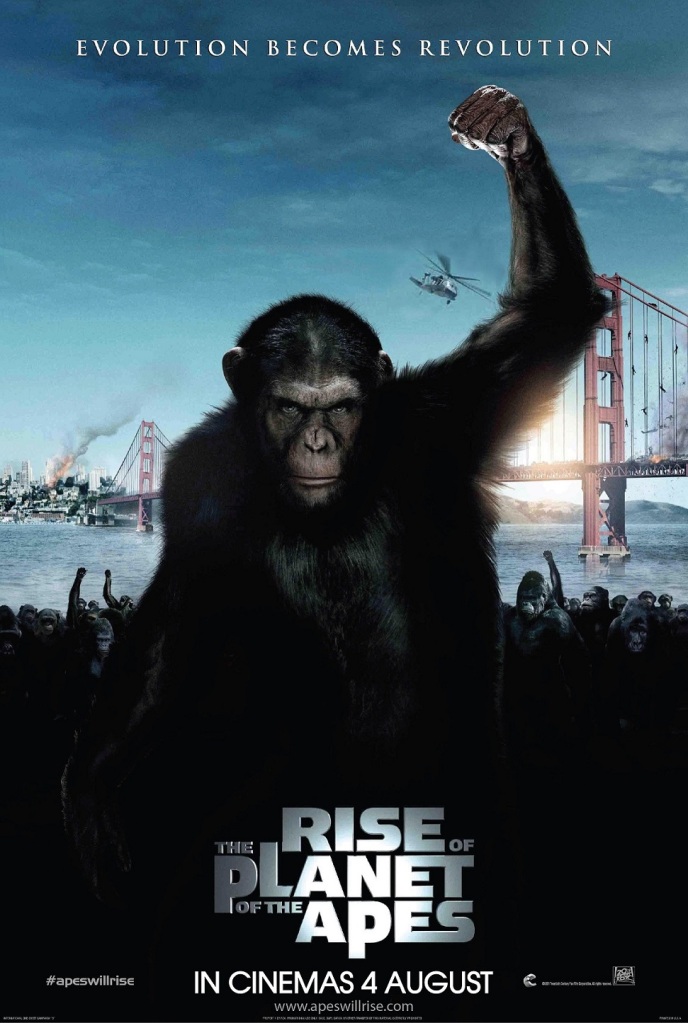
After decades languishing as a punchline in the wilderness of popular culture, Planet of the Apes got a long-overdue update in this 2011 feature, which is best understood as a quasi-canonical reboot for the franchise. Specifically, I would argue that this title is a prequel to the very first movie, going back to the original timeline — that is, ignoring the parallel version of history that branched off from the time-travel in Escape — to show how Earth started down the path towards eventual ape domination. There are still some plot holes to that approach, like how the future apes were taught that their ancestors were slaves and Aldo was the first of their kind to rebel against the masters, but it seems generally in line with what these filmmakers intended. (For example, a running thread in the background involves regular news reports about the Icarus spaceship going missing, and that was the name of the vessel that went off-course to bring Taylor and his crew crashing down to the planet where he met Dr. Zaius and the rest.) We’ve shifted focus from the threat of nuclear war to the risks of genetic tinkering, yet the moral thrust of the work still places humanity’s downfall as a consequence of our own misdeeds, with the apes serving as more of a lucky bystander recipient than the active agent of our doom.

But this is an intentional refresh for the series, so you don’t necessarily have to have seen any of the other films to follow along and enjoy it, fun as it is to spot the familiar lines of dialogue or the parallels to Conquest in particular. On its own terms, it’s a thrilling and heartfelt adventure that definitely carves out a distinct place for itself within the wider Apes narrative. If anything, its tale of a miraculous serum unlocking a worthy protagonist’s advanced powers recalls the superhero movies of the early 2000s, complete with the supporting presence of both Brian Cox and James Franco.

The storyline is pretty grounded compared to previous installments, especially once you accept the overall premise that an experimental superdrug to treat Alzheimer’s could boost the intelligence of its chimpanzee test subjects to the level of planning and carrying out a grand escape from captivity. (It’s a Rats of NIMH retelling! Kinda. And did I mention this came out the same year as Limitless?) Despite the title of the flick, the apes aren’t trying to launch a revolution to overthrow their oppressors at this point, merely to gather their brethren and reach the safety of the nearby forests across the Golden Gate Bridge. But a subplot neatly depicts how the viral treatment that’s made the apes smarter is also starting to spread throughout the human population, where it’s both highly contagious and fatal — rather chilling to rewatch now post-2020 — and thereby charts a plausible course from our reality to that of the ape-dominated future in the first movie. If the franchise had ended here, it still would feel like it had managed to come full circle and tell a complete story.

The characters are great too, with this Caesar getting more of a personal arc than his namesake in the 70s films. Both chimps are Moses figures, raised apart from their people and only belatedly learning the depth of their plight and taking on the mantle of saving them, but this one undergoes more of an obvious evolution in his growing disillusionment with humanity. In his final destructive charge across the city, he spares a few humans who have done him no harm, but he pointedly refuses to extend mercy to the actively abusive ones and in the end he coldly rebuffs the family that abandoned him. Throughout it all, the motion-capture CGI is a welcome change from the old makeup and masks and an impressive achievement even over a decade later, bringing him and the other apes to life in a way where you often genuinely forget that you’re not watching trained animal actors at work. (The 2001 Tim Burton film, to its shame, remains the only entry in the franchise to utilize any actual non-human primates.) It’s a bold new start, and one of my absolute favorites.

[Content warning for gun violence and gore.]

★★★★★

Like this review?
–Throw me a quick one-time donation here!
https://ko-fi.com/lesserjoke
–Subscribe here to support my writing and weigh in on what I read next!
https://patreon.com/lesserjoke
–Follow along on Goodreads here!
https://www.goodreads.com/user/show/6288479-joe-kessler
–Or click here to browse through all my previous reviews!
https://lesserjoke.home.blog

Movie Review: Planet of the Apes (2001)

Movie #8 of 2024:

Planet of the Apes (2001)

The Planet of the Apes franchise went dormant in the 1970s after five films and two short-lived TV shows, but was brought back to the big screen for this Tim Burton production several decades later. It’s best understood as a reimagining of the first movie — or as an even looser adaptation of the original French novel — rather than a further installment in the same continuity. The piece thus revolves around Mark Wahlberg as a new human astronaut in the old Charlton Heston role, crash-landing on an alien planet where talking apes reign supreme over our own species. (Heston himself gets a cameo appearance as an ape, which is fun, and a few of his more famous lines of dialogue are repurposed.) This version eschews the classic twist that the world is Earth’s future, but it does spring a similar reveal midway through: humans and apes from the protagonist’s time were the progenitors of intelligent life there, and he’s fallen across millennia to reach their descendants.

The story is alright, for the most part. Burton’s main attention seems to be on the visuals and background details, which range from impressive in the case of Paul Giamatti’s orangutan character to extremely off-putting in the case of Helena Bonham Carter’s chimpanzee. Tim Roth as the villain growls and bellows and jumps around a lot, though his motivations and the exact cause of his rage go unexplained. Meanwhile, the underclass of local humans have retained the power of speech, but they don’t do much with it; this is definitely one of those Hollywood pictures that designates a woman as the love interest by default simply for standing near the leading man.

In the end, Captain Leo escapes as Colonel Taylor was never able to, and the apes and humans he leaves behind have committed to reconciling and living in peace. But then the plot closes on a bizarre sequence that cribs off the ending of the book, with the hero arriving back on contemporary Earth to find that apes are now the dominant lifeform. The idea that they took over in his absence would be fine, and in line with what happens in the source material, but somehow the Lincoln Memorial in DC has also been changed to depict Roth’s General Thade, which is significantly harder to explain. (My best attempt would be to theorize that the antagonist at some point traveled back into Earth’s past, beating Marky Mark there, and altered the course of history so that his people overthrew ours. But that doesn’t really account for how all the familiar trappings of our culture like specific architectural landmarks, the design of police cars, and so on remain identical, and it’s certainly not spelled out in the script.)

The striking visual of Thade in place of Lincoln is a surface-level twist that’s plainly meant to recall the 1968 Statue of Liberty scene, and perhaps to set up a sequel that never materialized before the series was rebooted again in 2011. But it just fundamentally doesn’t make much sense, which is a frustrating but apt way for this curiosity to resolve.

[Content warning for gun violence, slavery, and torture.]

★★★☆☆

Like this review?
–Throw me a quick one-time donation here!
https://ko-fi.com/lesserjoke
–Subscribe here to support my writing and weigh in on what I read next!
https://patreon.com/lesserjoke
–Follow along on Goodreads here!
https://www.goodreads.com/user/show/6288479-joe-kessler
–Or click here to browse through all my previous reviews!
https://lesserjoke.home.blog

Movie Review: Battle for the Planet of the Apes (1973)

Movie #7 of 2024:

Battle for the Planet of the Apes (1973)

A perfunctory conclusion to the original Planet of the Apes movie series, although the franchise would live on in television shows, comic books, an odd Tim Burton reimagining, and an eventual big-screen reboot in 2011 that’s still ongoing today. In this film, the uprising in Conquest has won the apes their freedom (at least in this one small area of the world), and they now dwell in a tentative peace with their former masters, who have been relegated to second-class citizens and taught never to use the word “no.” Off-screen between installments, a nuclear war has helped destroy much of human civilization, and all apes have apparently learned to speak like Caesar. The chimpanzees, gorillas, and orangutans believe they are naturally better than humans because they are not as prone to violence, although it’s clear that this attitude is entrenching old divisions and hiding the corrupting role of social privilege, even for audiences who haven’t seen Charlton Heston on the receiving end of ape brutality.

Our returning chimp protagonist is worried over whether that future that his parents came from is inevitable or not, and so he decides to seek out the archived recordings of them still housed in the ruins of a nearby city, in order to hear their words for himself. There he runs afoul of an old enemy and his servants, all of whom have been mutated by radiation (presumably on their way to becoming the ancestors of the underground psychics in Beneath). Though most individuals on both sides would rather not fight, misunderstanding ensues and the conflict of the title soon breaks out.

Meanwhile, an aggressive gorilla named Aldo is seething under Caesar’s imposed pacifism and plotting to seize power. In the process, he kills the leader’s son for eavesdropping on his schemes, which causes the rest of his society to realize that apes are perhaps not so morally superior to humans after all. The hero has also learned from his father’s tape that Aldo was the name of the ape slave who stood up against humanity in his timeline, supporting his friend Virgil the orangutan’s theory that history can indeed be changed. Caesar renews his commitment to peaceful coexistence, and a framing device with the legendary ape Lawgiver 600 years hence suggests that his efforts are working out and that the oppressive situation encountered by Taylor the astronaut may not ever come to pass.

As a finale it works, but it’s bland and plodding storytelling overall, with lots of scenes of generic forces running and exchanging gunfire. Not the worst of its era, but hardly a highlight either.

This movie: ★★★☆☆

Overall series: ★★★★☆

Movies ranked: 1 > 3 > 4 > 5 > 2

Like this review?
–Throw me a quick one-time donation here!
https://ko-fi.com/lesserjoke
–Subscribe here to support my writing and weigh in on what I read next!
https://patreon.com/lesserjoke
–Follow along on Goodreads here!
https://www.goodreads.com/user/show/6288479-joe-kessler
–Or click here to browse through all my previous reviews!
https://lesserjoke.home.blog

Movie Review: Conquest of the Planet of the Apes (1972)

Movie #6 of 2024:

Conquest of the Planet of the Apes (1972)

By this point in the initial Planet of the Apes series, viewers had seen a future world where our species had been overthrown, its apocalyptic destruction, and a tragedy wherein the only surviving refugees of that dystopia, having traveled back in time to our day with expressions of friendship and pacifism, wind up getting brutally murdered due to local xenophobia. In that last installment, we even learned details from ape history about humanity’s downfall in their original timeline: a plague wiped out other animals like cats and dogs, humans enlisted apes as pets and then slaves, and the mistreated underclass ultimately rose up against us.

This next sequel thus turns naturally to depicting that particular conflict. It’s not quite how Cornelius and Zira described it — either because their arrival in the past changed things, or because the account hadn’t been passed down faithfully to them in the first place, or just because the continuity across these films isn’t really as airtight as one might hope. But generally speaking, the state of Earth’s society a couple decades after Escape is in line with what those visitors said. Their son, swapped with a regular chimpanzee at birth to protect him, is now fully grown (and played by his late father’s actor, Roddy McDowall). He’s been brought up away from civilization by a kindly circus-owner, and is shocked at the start of events to finally see his people’s plight firsthand. When he reveals his power of speech by yelling out, “Bloody human bastards!” — which his friend tries in vain to claim was his own comment of “inhuman” — he’s forced to flee and hide amongst his mute peers, helping them strategize and slowly build a movement towards revolution.

This Apes film, more than any other, leans very strongly into the underlying racial allegory that’s always been a part of the franchise. (It’s also the entry that the later rebooted movies most clearly draw their inspiration from, whether relatedly or not.) The way the other primates are treated is specifically modeled after the worst abuses of historical slavery, with chains and auctions, beatings for disobedience, forced breeding, patronizing assertions of their inferior mental abilities, and beyond. The one Black character in the cast both disapproves of this treatment and is subjected to racist comments over his real and perceived sympathies, and the climactic struggle at the end of the movie is framed like a contemporary race riot, complete with armored police ordering the protesters to disperse.

It’s easy to root for the apes here like the script intends, but the conclusion pulls its punches a bit. After the simian forces have won and the cruel governor lies trembling at their feet, Caesar undergoes a curious change of heart and instructs them in sudden religious language that he’s never used before to show mercy and let the man go. It’s a whip-turn reversal in the middle of his closing monologue, which conspicuously plays out from there onward in voiceover, closeups of his eyes, and looping and reversed footage from earlier in the scene. The truth is that the intended ending made the bolder choice to commit to the triumphant hero overseeing the defeated villain’s death and crowing about the masters meeting their destined fate, but test audiences complained so much that it was reworked ahead of its release. That’s a bummer, but it’s still one of the better installments of its era overall.

★★★★☆

Like this review?
–Throw me a quick one-time donation here!
https://ko-fi.com/lesserjoke
–Subscribe here to support my writing and weigh in on what I read next!
https://patreon.com/lesserjoke
–Follow along on Goodreads here!
https://www.goodreads.com/user/show/6288479-joe-kessler
–Or click here to browse through all my previous reviews!
https://lesserjoke.home.blog

TV Review: Star Wars: Tales of the Empire, season 1

TV #20 of 2024:

Star Wars: Tales of the Empire, season 1

This six-part animated Star Wars anthology is pretty clearly modeled on the similar Tales of the Jedi project from 2022, and it inherits some of the same structural weaknesses. At least this time around, the story pushes forwards for one of its two focal characters — Barriss Offee, a former Jedi last seen getting locked up for bombing the temple during the Clone Wars — and doesn’t just provide general background filler, as was largely the case before. Here we learn that that protagonist subsequently became an Imperial Inquisitor for a while, before losing faith in their mission and returning to her old Jedi ways.

The other half of this season, though, is spent on Thrawn’s loyal servant Morgan Elsbeth from the live-action Mandalorian and Ahsoka shows, whose backstory proves not particularly revelatory. This is solid but unremarkable Star Wars for the most part, and although it isn’t the worst of the franchise, it never comes close to justifying its existence, especially as a separate series rather than Tales of the Jedi season 2.

★★★☆☆

Like this review?
–Throw me a quick one-time donation here!
https://ko-fi.com/lesserjoke
–Subscribe here to support my writing and weigh in on what I read next!
https://patreon.com/lesserjoke
–Follow along on Goodreads here!
https://www.goodreads.com/user/show/6288479-joe-kessler
–Or click here to browse through all my previous reviews!
https://lesserjoke.home.blog

Book Review: Alien Scream by Chris Archer

Book #75 of 2024:

Alien Scream by Chris Archer (Mindwarp #3)

Easily the best entry so far in my reread of this 90s middle-grade sci-fi series. The formula is pretty firmly established by this point — a kid in the small Wisconsin town turns 13, develops strange powers, and winds up getting attacked by a shapeshifting alien assassin — but the teens have such different abilities and personalities that it hasn’t grown repetitive just yet. Our latest protagonist is a laid-back class clown who suddenly gains the ability to speak / sign every language fluently, and while that may not seem useful in a fight, by the end of this novel he’s learned he can also understand and command swarming insects like termites and ants and send faxes over the phone with only his voice. (Look, it was more impressive back when this was written, okay?)

What really elevates this volume above its predecessors is the stronger characterization, the fun of seeing both previous heroes from a new perspective, and the ensuing crossover / team-up vibes, although for now the group is simply sharing notes on their respective experiences and trying to decipher the sinister conspiracy against them, not actually joining together in combat. I also appreciate author Chris Archer’s deft hand at writing a teenage crush that’s obviously mutual — to this adult reader, at least — while keeping the first-person POV narrator oblivious and sweetly worried about embarrassing himself.

(Newsflash, Jack: she stopped by your table to wish you a happy birthday, walked you to the nurse’s office after you hit your head, and called your house later to check up on you. I know you feel like you can’t trust anyone, and that the version of her you saw near the end of the book was in fact an imposter who knocked you out and strapped you to a bomb, but I do think that the real girl might prove receptive if you ever worked up the courage to ask her out.)

Great genre silliness, carried off well. I remember very little of how the story goes on from here, but I’m totally on-board after this installment.

★★★★☆

Like this review?
–Throw me a quick one-time donation here!
https://ko-fi.com/lesserjoke
–Subscribe here to support my writing and weigh in on what I read next!
https://patreon.com/lesserjoke
–Follow along on Goodreads here!
https://www.goodreads.com/user/show/6288479-joe-kessler
–Or click here to browse through all my reviews!
https://lesserjoke.home.blog

TV Review: Star Trek: Picard, season 3

TV #19 of 2024:

Star Trek: Picard, season 3

The first two seasons of this Star Trek: The Next Generation sequel were generally at their strongest in those moments that reunited the cast of the original show, which is probably why this last year goes ahead and makes it a full-fledged reunion. As before, there’s a real thrill from seeing the old crew together again, but the plot mechanics to get us to that point are a little rough and coincidence-heavy. (Picard’s new friend Raffi is working with Worf even before they’re dragged into the admiral’s orbit? Why?) It’s also nice that this season doesn’t feel obligated to shoehorn in all the regular Picard characters like Elnor or Agnes, though that admittedly adds to the unevenness of the program at large.

The core of this new story is neat, offering a paranoid conspiracy thriller of Changelings infiltrating Starfleet, where no one is sure who else can be trusted. It’s a premise that Trek has already gone to in Deep Space Nine and other titles, but it’s still handled pretty well this time around. The fact that the enemies also want Picard and the adult son he’s just met is somewhat strange, however, with the eventual explanation and connection to the Borg not particularly satisfying. There’s no effort to justify why those two species would ever team up, or to reconcile these Borg with the redemption / evolution that another faction underwent last season on this show.

Plus, as fun as all the TNG callbacks are — we even get Ro Laren and holodeck Moriarty for some reason — they tend to draw attention to who hasn’t been included in this adventure. No sign of Wesley Crusher or Guinan, both of whom have popped into the Picard series before and presumably would have liked to see their old friends and family too, and no mention at all of Miles O’Brien! Heck, if Data can be brought back for the umpteenth time here — continuing to lessen the impact of all his previous deaths — then I really need an accounting of why Tasha Yar couldn’t be resurrected in some fashion as well, even if simply for a quick cameo as a Changeling taunt. Similarly, while Tuvok makes his first canonical Trek reappearance since Voyager ended, his emotional scenes with Seven of Nine only underscore how her stronger relationship was always with Janeway, who gets referenced but not actually shown.

This series has never come close to living up to its nostalgic potential, even / especially for a viewer like me with merely a passing fondness for the earlier Patrick Stewart show, but at least it manages to end on a surer footing than it began.

This season: ★★★☆☆

Overall series: ★★★☆☆

Seasons ranked: 3 > 2 > 1

Like this review?
–Throw me a quick one-time donation here!
https://ko-fi.com/lesserjoke
–Subscribe here to support my writing and weigh in on what I read next!
https://patreon.com/lesserjoke
–Follow along on Goodreads here!
https://www.goodreads.com/user/show/6288479-joe-kessler
–Or click here to browse through all my previous reviews!
https://lesserjoke.home.blog

Movie Review: Escape from the Planet of the Apes (1971)

Movie #5 of 2024:

Escape from the Planet of the Apes (1971)

A welcome bounce back for the series. Like its two predecessors, there’s a fatalistic darkness to this Apes film, but it’s carried off better here in balance with a certain comic playfulness. The producers wrote themselves into a corner by concluding the prior adventure with a bomb blowing up the entire planet (and presumably all our known characters with it, though several had already been shot to death by then), but this next sequel concocts an ingenious solution to that problem: time-travel! Since chimpanzee scientists Dr. Zira and Dr. Cornelius were conveniently absent from the final act of Beneath anyway, this script establishes that they were working with a genius friend on patching up the crashed spaceship from the first flick. Somehow, the three apes were able to launch it into orbit just before the doomsday weapon went off, and thus got to watch the world explode as they retraced Taylor’s trajectory backwards through space to modern Earth.

It’s a tad silly, but a great setup for the plot that follows. In a nod to the climax of the original novel — in which the hero flies home to discover that apes have taken over in his absence — this movie starts with contemporary humans swarming a spacecraft that’s just landed in the ocean, only for the astronauts to remove their helmets and reveal that they’re apes (and to cue up the title card with a funky 70s soundtrack). Though initially hesitant to disclose their intelligence and power of speech, the “apestronauts” ultimately do just that, setting them on an arc somewhat analogous to how Taylor was treated by their kind back home. Here, though, they’re welcomed as celebrity sensations after the initial disbelief and shock, and viewers get a rather glorious montage of their ensuing shopping spree and media blitz.

Cornelius and Zira have been staunch allies for the humans in the franchise all along, but their promotion to central protagonists is a good one. From this point forward, the Planet of the Apes series has its sympathies pretty firmly on the side of the apes, with humanity at large cast as the intolerant xenophobes (offset by the occasional exceptions in the role the chimpanzee couple used to occupy). Plus, by sending a small company of apes out of their home society and into the present day, this particular movie gets away with a significantly smaller makeup and sets budget, much like Star Trek IV: The Voyage Home or Galactica 1980.

The humans grow more worried about their visitors the more that they let slip about their own time and what they know of Earth’s history (some of which, unfortunately, seems to contradict the state of ape knowledge established in the first film). The new origin story for apekind: a plague killed off many animals, prompting humans to turn to our primate cousins for pets and then slaves. Eventually an ape named Aldo learned to say “no” and began a revolt movement, leading to the downfall of our species and its civilization.

Though those events are far in the future, the president’s scientific advisor Otto Hasslein — name-dropped in both previous movies for his theories on relativistic space travel — fears that Zira’s unborn child will represent a bridgehead force precipitating man’s early decline. The apes are interrogated more harshly, with a specific focus on the devastation they witnessed in the war and Zira’s confessed medical experimentation on live human subjects. Hasslein ultimately procures authorization to neuter the chimps and end their pregnancy, spurring them to break out of their government holding facility and go on the run before he can. Though the scientist is ordered to take the fugitives alive, he instead shoots Zira and her newborn baby and is subsequently killed by Cornelius in revenge, who then gets slain by sniper fire himself. So much for our heroes, once again.

It’s the third downbeat ending in a row for the franchise, but there’s one further twist before the credits roll. Earlier Zira and Cornelius had stayed briefly at a traveling circus where an ordinary chimpanzee had recently given birth herself, and it’s now revealed that the two mothers swapped babies off-screen. Milo — named for their companion who died in a mishap near the start of the film — is the infant who’s still alive, and the movie ends with him exclaiming, “Mama! Mama!” in a manner eerily reminiscent of the doll Taylor found back in the Forbidden Zone that proved ancient humans could talk. It’s not quite a Terminator-style causality loop, but it does appear that Hasslein may have inadvertently helped bring about the exact fate he was trying to prevent. All in all, a neat little piece of science-fiction.

★★★★☆

Like this review?
–Throw me a quick one-time donation here!
https://ko-fi.com/lesserjoke
–Subscribe here to support my writing and weigh in on what I read next!
https://patreon.com/lesserjoke
–Follow along on Goodreads here!
https://www.goodreads.com/user/show/6288479-joe-kessler
–Or click here to browse through all my previous reviews!
https://lesserjoke.home.blog

Design a site like this with WordPress.com
Get started